
You acquired them. They bought once — maybe twice. And then they vanished.
No complaint. No unsubscribe. They just… stopped.
If you run an e-commerce brand, this is probably one of your most expensive problems — and one that's surprisingly easy to overlook. Most retention efforts focus heavily on getting the second purchase. But once a customer buys again, many brands assume loyalty is on its way.
That's a costly assumption.
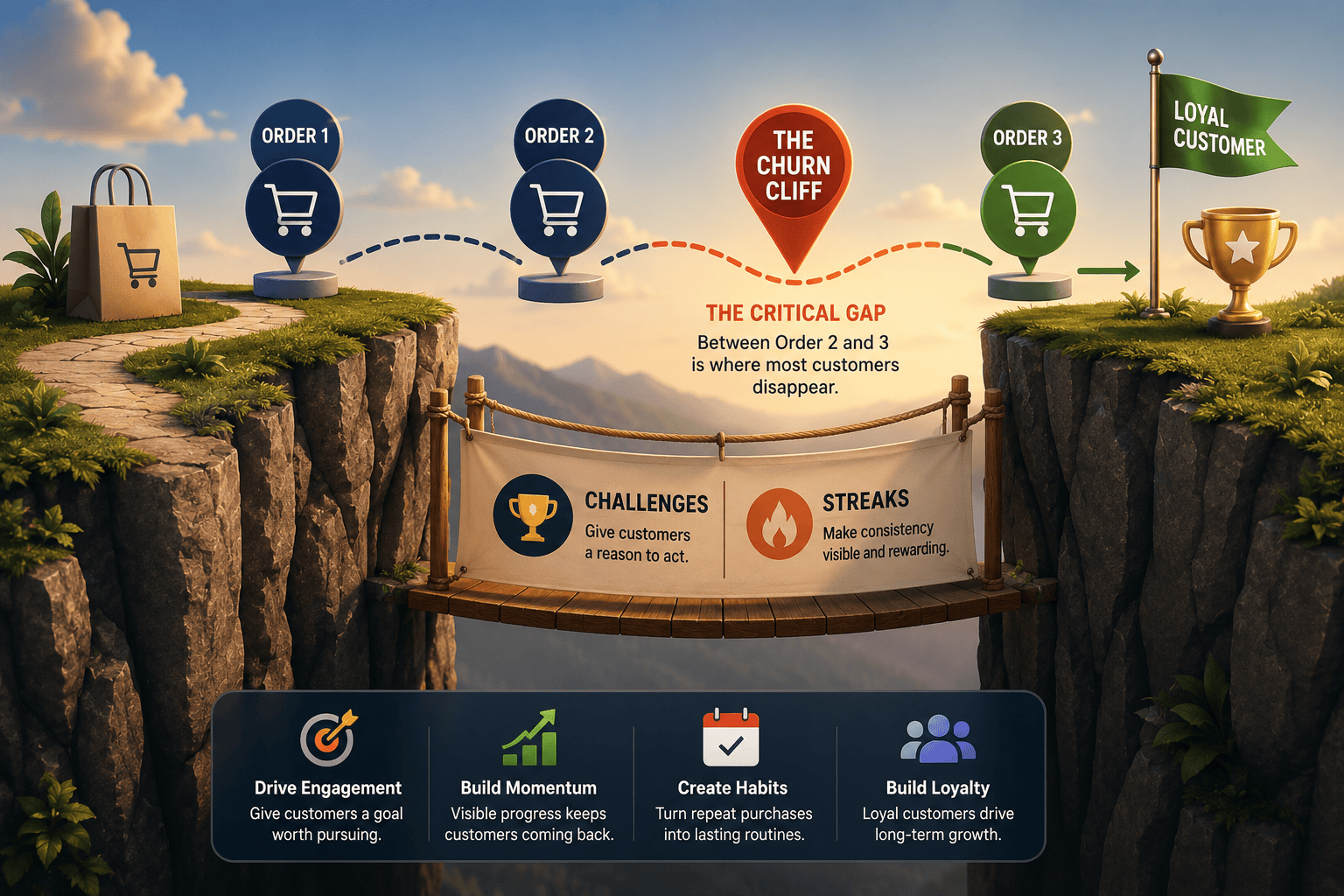
The period between Order 2 and Order 3 is one of the most important moments in the customer lifecycle. It's the point where customers move beyond trying your products and begin deciding whether your brand deserves a permanent place in their routine.
We call this moment the Churn Cliff—the narrow window where future loyalty is often decided.
Why the Second Order Is a Trap
Getting a customer to buy twice feels like a win. And it is.
But it's also the moment many brands unintentionally stop giving customers a reason to come back.
After the first purchase, customers are naturally engaged. They're curious about your brand. They're evaluating the product. Every interaction feels new.
By the second purchase, that novelty has faded. The customer has already decided your product is worth buying again. What they haven't decided is whether your brand deserves to become part of their routine.
They're in an in-between state: not loyal, not churned. Just... waiting.
Unfortunately, this is often when brands go quiet.
The welcome sequence has ended. The post-purchase emails stop arriving. The discount that encouraged the second purchase has already been used.
Without a compelling reason to return, customers don't necessarily switch to a competitor.
They simply drift away.
The Churn Cliff isn't dramatic. It's silence.
What the Data Suggests
One of the largest published analyses of ecommerce buying behavior examined 18 million customers across 176 online retailers. The study found that only 32% of first-time customers placed a second order within their first year. But once customers reached a second purchase, their likelihood of buying again increased substantially. Among customers who made a second purchase, 53% went on to make a third, and among third-time buyers, 64% returned for a fourth.
The exact percentages vary across industries and product categories, but the pattern is remarkably consistent:
Every additional purchase increases the likelihood of another.
That's why the journey from Order 2 to Order 3 matters so much.
By the third purchase, customers have overcome multiple buying decisions. They've trusted your product repeatedly, experienced your fulfillment process more than once, and started integrating your brand into their lives. Loyalty isn't guaranteed—but it's beginning to take shape.
Why Traditional Retention Falls Short
When customers stop buying, the default response is usually another discount.
"We miss you."
"Here's 15% off."
"Offer expires in 48 hours."
Sometimes it works.
But over time, discounts teach customers to wait for incentives instead of creating genuine attachment to your brand. You don't build loyalty—you rent attention.
Other brands respond with more email, more SMS, more retargeting ads.
The problem isn't that customers have forgotten you.
It's that they don't have a compelling reason to return right now.
Discounts and reminders are passive. They interrupt.
They don't create momentum.
Behavioral Momentum Beats Discounts
The brands that successfully bridge the gap between Order 2 and Order 3 aren't necessarily the ones with the biggest discounts.
They're the ones that give customers something to do.
This is where gamification—specifically Streaks and Challenges—becomes much more than a marketing gimmick.
A Challenge gives customers an active role in their relationship with your brand.
Instead of reacting to another promotion, they're pursuing a goal.
Progress becomes visible.
Completion becomes satisfying.
The next purchase isn't simply another transaction.
It's the next step toward something they've already started.
How Challenges Bridge the Churn Cliff
Imagine a specialty coffee brand.
Instead of sending another coupon after Order 2, they enroll customers in a Coffee Explorer Challenge:
Try three different single-origin coffees within 60 days and unlock an exclusive brewing guide plus early access to seasonal blends.
Now the customer has a story.
They're not simply buying coffee.
They're completing something.
Order 3 no longer feels like "buy again."
It feels like meaningful progress.
Behavioral science helps explain why this works.
According to Robert Cialdini's research on commitment and consistency, once people voluntarily take a step toward a goal, they're more likely to continue pursuing it.
Challenges also benefit from what's known as the Zeigarnik Effect—our tendency to remember unfinished tasks better than completed ones. An incomplete challenge stays mentally "open," making customers more likely to return and finish what they started.
A customer participating in a challenge is psychologically different from one who simply received a coupon.
Challenges also solve a timing problem.
Discounts only work if the customer is already thinking about buying when the offer arrives.
Challenges remain relevant between purchases.
The customer thinks about the challenge when they're ready to buy—not just when your marketing email appears.
The Streak Layer: Making Consistency Visible
Challenges become even more powerful when paired with Streaks.
A streak makes consistency visible.
A customer with a three-month purchase streak isn't simply buying again.
They're protecting progress they've already earned.
The psychological cost of breaking a streak is surprisingly powerful.
Between Order 2 and Order 3, that streak is still fragile.
But surfacing it—
"You're on a two-month streak. Keep it going."
—creates an emotional reason to continue that goes beyond product value.
The streak quietly communicates:
You've already started something here.
Breaking it feels like losing progress.
Continuing it feels like building momentum.
Designing for the Churn Cliff
If you want to bridge the gap between Order 2 and Order 3, the design principle is simple:
Intervene before customers disappear—not after.
Most brands wait until customers become inactive before trying to re-engage them.
That's fighting uphill.
Instead, introduce challenge mechanics immediately after the second purchase, while customers are still engaged and deciding whether your brand deserves another visit.
A few principles make challenges significantly more effective.
Make the goal achievable
A challenge like "Buy three times this quarter" feels realistic.
A challenge requiring ten purchases doesn't.
Goals should feel attainable—that's what makes progress motivating.
Reward the relationship, not the purchase
Offer rewards that strengthen the relationship with your brand:
- Early access to new products
- Exclusive collections
- VIP status
- Premium educational content
- Free samples
These rewards reinforce why customers engage with your brand.
A percentage discount simply reinforces price.
Make progress impossible to ignore
Customers shouldn't have to visit an account page to discover they're halfway through a challenge.
Celebrate milestones.
Show remaining progress.
Make the journey visible across email, SMS, or your storefront.
Keep the mechanic simple
If it can't be explained in one sentence, it's probably too complicated.
Buy three times in 90 days to unlock Gold Status.
Customers should understand the goal immediately.
The Cliff Is Crossable
Every ecommerce brand invests heavily in acquiring new customers.
Far fewer intentionally design the journey between the second and third purchase.
Yet that's often where long-term habits begin.
Customers don't become loyal because they received one more discount.
They become loyal because they found a reason to come back.
Challenges, streaks, and visible progress transform repeat purchases from isolated transactions into an ongoing relationship.
If your customers are disappearing after their second order, the answer may not be another email or another promotion.
It may simply be giving them something worth returning to complete.
That's how repeat buyers become loyal customers.
Not through louder marketing.
Through meaningful momentum.
References
- RJMetrics. The Ultimate Guide to Customer Cohorts. Analysis of 18 million ecommerce customers across 176 retailers.
- Robert B. Cialdini. Influence: The Psychology of Persuasion.
- Bluma Zeigarnik. On Finished and Unfinished Tasks (1927).
Gamopanda helps ecommerce brands build challenge and streak mechanics that increase repeat purchases and customer loyalty—without relying on endless discounts.