
Every hotel operator knows Online Travel Agencies, or OTAs — Booking.com, Expedia, Agoda — take a cut. Fewer have actually sat down and worked out what that cut costs them over a guest's lifetime — and how much of it is avoidable by simply giving guests a reason to book direct.
1. The Commission Math
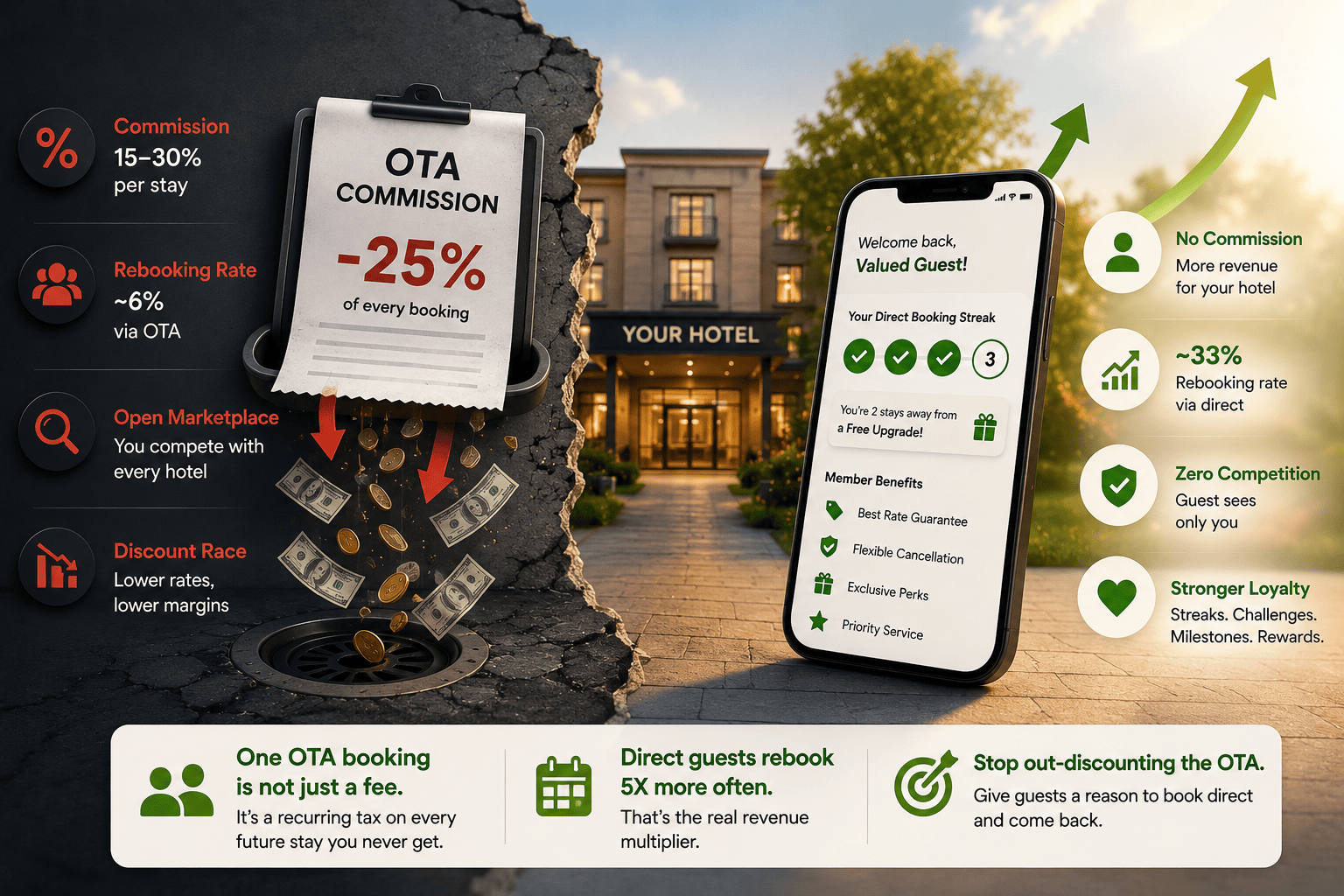
Booking.com, Expedia, and Agoda don't just take a slice of a single reservation. They take a slice of every reservation, every time, for as long as a guest keeps booking through them instead of booking direct. OTA commission rates typically fall between 15–25% per booking, and can climb past 25–30% once promotional placement fees are factored in.
Run that against a mid-market property doing $150 average daily rate. A guest who books five nights a year through an OTA is handing over somewhere between $112 and $225 in commission annually — money that never touches the hotel's own guest relationship, own data, or own repeat-booking funnel.
The Core Truth: A single OTA booking isn't a one-time fee. It's a recurring tax on every future stay that guest never gets the chance to book directly.
2. The Number That Actually Matters: Rebooking Rate
Commission on a single stay is the visible cost. The invisible cost is what happens after that stay — and this is where the gap becomes hard to ignore. Guests acquired through a hotel's own CRM rebook at roughly 33%, compared to around 6% for guests acquired via an OTA.
That's a guest who books through your own channel being roughly five times more likely to come back than one who found you through a third party. Every OTA-only guest is, on average, several lost future stays — not one transaction, but a whole relationship that never gets the chance to compound.
3. The Open Marketplace Problem
Commission is a fee. What OTAs actually are is a marketplace, and a marketplace by definition puts your hotel next to every competitor within a five-mile radius, sorted by price.
A guest who searches your hotel's name directly on Booking.com or Expedia isn't shown only your hotel. They're shown a results page, and every competing property on that page can run sponsored placement to sit above you — including properties actively bidding to intercept searches for your own brand name. You're not just paying a fee to be listed. You're paying a fee for the privilege of being one option among several a competitor can buy their way in front of.
Discounting inside that environment makes it worse, not better. Cut your rate to win the OTA slot, and you're no longer competing against the hotel down the street — you're competing against your own margin. It's a race where the "prize" is a guest hosted at a rate that barely covers cost, on a platform that will happily show that same guest a better-looking deal from someone else next time. The open marketplace doesn't just cost commission — it trains guests to comparison-shop your own hotel every time they think about coming back.
None of this is a reason to abandon OTAs; they remain a real acquisition channel, especially for first-time guests who've never heard of your property. It's the reason a hotel can't treat OTA volume as a proxy for guest relationship.
4. Direct vs. OTA: The Real Comparison
| Factor | OTA Booking | Direct Booking |
|---|---|---|
| Commission | 15–30% per stay | None |
| Guest Relationship | Owned by the OTA | Owned by the hotel |
| Rebooking Rate | ~6% | ~33% |
| Competitive Exposure | Shown next to rivals, every time | Zero — guest sees only you |
5. What Streaks and Challenges Look Like in Practice
Points and tiers try to win this fight by matching the OTA on price — a discount for a discount. Streaks and challenges win it differently: they make the direct channel itself the more interesting place to book, so the comparison-shopping instinct never kicks in.
- The direct-booking streak. A guest earns streak credit only when booking through the hotel's own site or app — never through an OTA. Three direct stays in a row unlocks something the guest wants (a room upgrade, a late checkout, a spa credit). Breaking the streak by booking through an OTA makes the guest see exactly what they gave up.
- The seasonal challenge. Instead of a 12-month points cycle resetting quietly in the background, run a visible, time-boxed challenge: "Stay with us twice before the end of summer and your third stay includes a free upgrade." A clear deadline creates urgency an OTA's static price comparison can't replicate.
- The milestone that isn't about spend. A milestone tied to behavior — "your 5th direct booking," "your 2nd stay this year," "referred your first friend" — recognizes the guest relationship itself, not just the invoice size. This matters most for boutique properties, where a modest but frequent guest is often worth more long-term than a big spender who never returns.
- The referral-linked unlock. A guest who refers a friend and both parties book direct unlocks a joint reward — a shared discount, a paired upgrade, a bottle waiting in both rooms at check-in. It drives a new direct booking while reinforcing the original guest's own habit.
What all four share: none of them try to out-discount the OTA. They give the guest a reason to prefer the direct channel that has nothing to do with price — visibility into their own progress, a deadline, recognition, or a shared reward with someone they know.
Stop trying to out-discount the OTA on price. Give guests something an OTA can't offer at all: a streak, a deadline, and a reason to come back that has nothing to do with rate.
Conclusion
The OTA commission is the cost everyone already sees on the invoice. The rebooking gap, the open-marketplace exposure, and the discount race are the costs that never show up anywhere — until you go looking for them. For an independent or boutique property, the fix isn't matching a global chain's points economy. It's giving repeat guests something lightweight and immediate to track, so that the next booking happens on your own site instead of someone else's marketplace.
Gamopanda helps ecommerce brands build challenge and streak mechanics that increase repeat purchases and customer loyalty—without relying on endless discounts.