
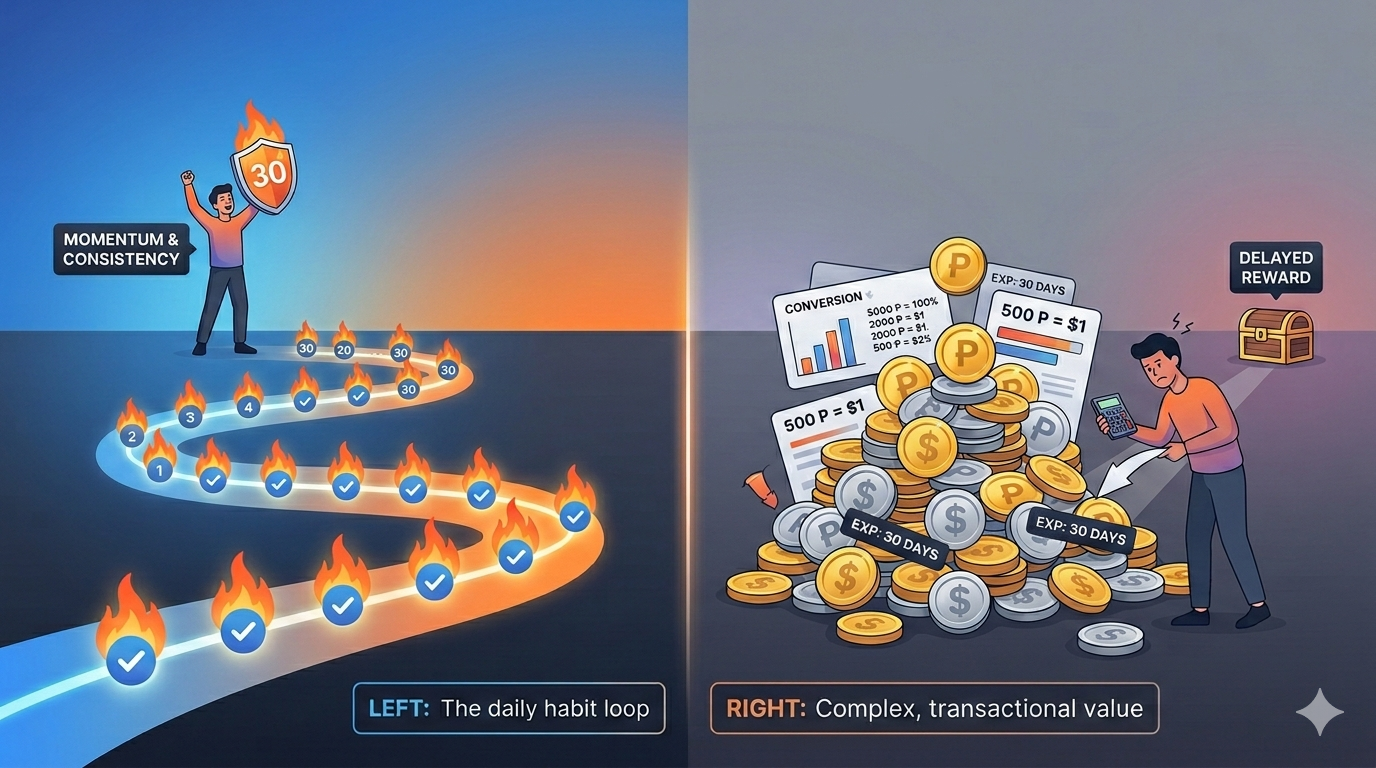
For decades, the "Spend $1, Get 1 Point" model has been the gold standard of customer retention. However, as consumer attention spans dwindle, brands are discovering a more potent psychological lever: The Streak.
From Duolingo to Snapchat and fitness apps like Strava, streaks are redefining engagement. But why does a simple counter of consecutive days perform better than a bank of redeemable points?
1. Loss Aversion vs. Delayed Gratification
Traditional loyalty points rely on delayed gratification. A customer must shop for months to earn enough points for a reward. This requires long-term planning—a cognitive tax most users won't pay.
Streaks leverage Loss Aversion. Once a user has a 50-day streak, the psychological "cost" of breaking it is higher than the perceived value of a reward.
The Core Truth: Humans are hardwired to avoid losing what they have already built. The pain of "starting over" is a more powerful motivator than the joy of an incremental point gain.
2. Radical Simplicity (Low Cognitive Load)
Points systems are often a math problem. Customers have to calculate exchange rates (e.g., "What is 5,000 points worth?") and track expiration dates.
Streaks remove the friction:
- Binary Outcome: Did you show up today? Yes or No.
- Dopamine Hit: The number increments instantly. No waiting for a monthly statement.
- Momentum: There is no "value" to calculate, only a chain to keep unbroken.
3. The Showdown: Points vs. Streaks
| Feature | Traditional Points | Streaks / Consistency |
|---|---|---|
| Primary Driver | Financial Incentive | Psychological Momentum |
| Emotional State | Transactional | Habitual / Protective |
| Redemption | High Friction (Wait months) | Instant (The "Check" is the reward) |
| Liability | Debt on Balance Sheet | Zero Cost Asset |
4. Identity and Social Signaling
Traditional points are private. Nobody brags about their grocery store point balance.
Streaks are identity-driven. A "365-day streak" is a badge of honor. It tells the world: "I am a disciplined person." By focusing on the streak, your brand stops being a vendor and starts being a partner in the user's self-improvement journey.
Stop asking how much your customers are spending, and start asking how often they are showing up.
Conclusion
While points still work for high-value, low-frequency industries like banking, the future of SaaS and E-commerce is habit-based. Build a streak, build a habit, and you'll build a customer for life.