
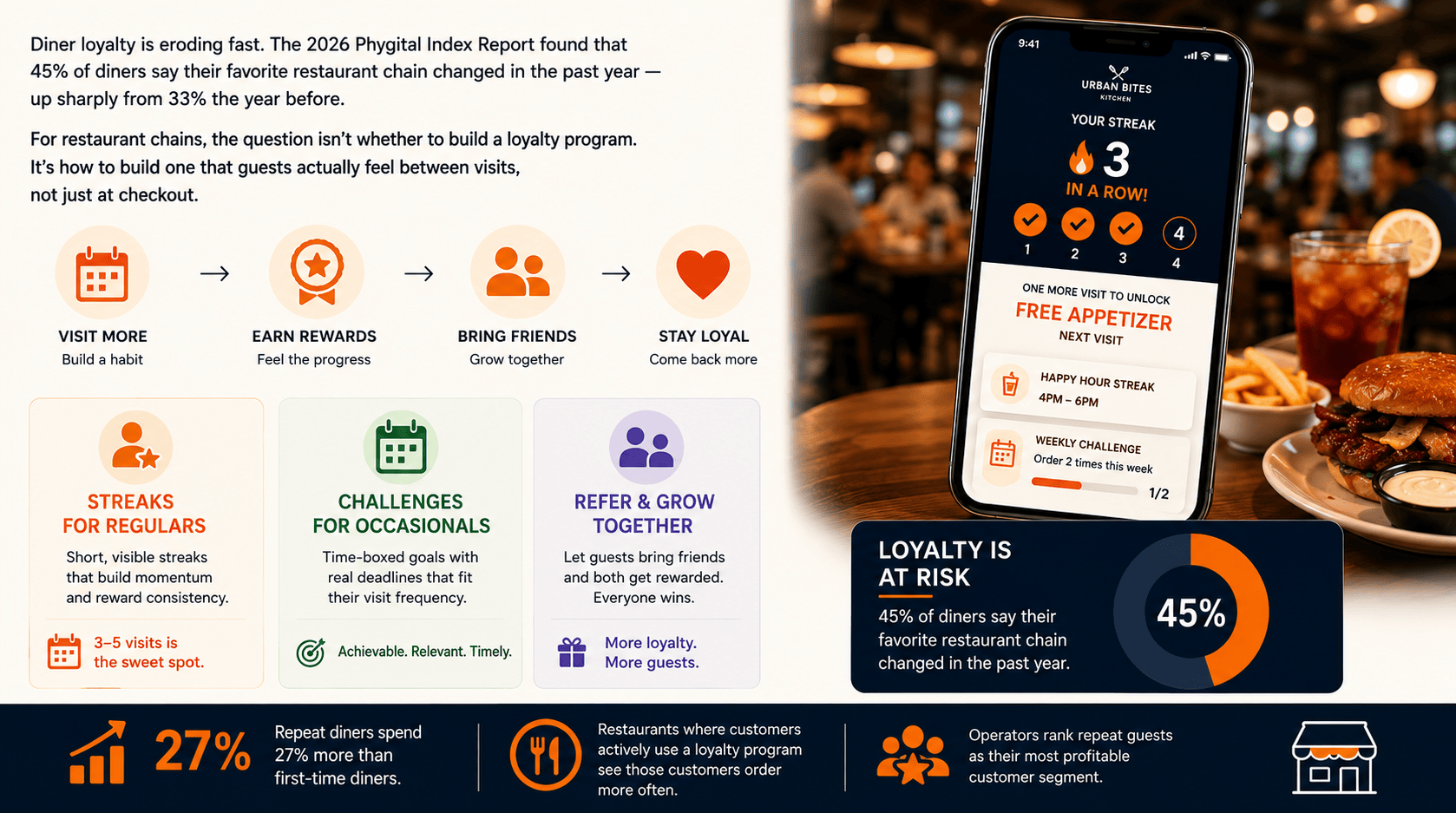
Diner loyalty is eroding fast. The 2026 Phygital Index Report found that 45% of diners say their favorite restaurant chain changed in the past year — up sharply from 33% the year before. For restaurant chains, the question isn't whether to build a loyalty program. It's how to build one that guests actually feel between visits, not just at checkout.
Streaks and challenges are one answer. Here's a practical framework for building them.
1. Start With Visit Frequency, Not a Universal Reward Cycle
The single most important design decision is matching the reward cycle to how often a guest actually visits. Reward pacing that's off by even a small margin breaks the whole mechanic — a weekly visitor completing an 8-visit streak gets there in about 8 weeks, but a monthly visitor chasing the same 8 visits needs 8 months, and momentum dies long before the reward arrives.
That means before designing a single mechanic, segment your guest base by visit frequency:
| Guest Segment | Typical Cadence | Streak Mechanic |
|---|---|---|
| Daily/Weekly Regulars | Coffee, QSR, lunch crowd | Short streak, 3-5 visits |
| Bi-Weekly Diners | Casual dining | Rolling challenge, 2-4 weeks |
| Monthly/Occasional | Full-service, special occasion | Seasonal challenge, not a streak |
A single restaurant chain often needs all three running simultaneously across different guest segments — not one mechanic forced onto everyone.
The Core Truth: A streak only works if the guest can realistically complete it. A mechanic paced for a weekly regular will feel impossible to a monthly diner, and one paced for a monthly diner will feel pointless to a regular.
2. Build the Visit Streak for Your Regulars
For your highest-frequency guests, a short, visible streak works better than a long points climb. A guest who orders three weeks in a row unlocks something small and immediate on the fourth visit — not a distant threshold, but a short chain they don't want to break.
The design principles that make this work:
- Keep it short. Three to five visits is enough to build momentum without feeling like a chore.
- Make it visible. The guest should be able to check their streak status without digging through an app menu — a number they see the moment they open the ordering screen.
- Reward immediately. The value of a streak is protecting something already built. If the payoff is delayed, the psychological hook disappears.
Example: the Happy Hour streak. A chain trying to build a habit around its slowest window — say, weekday happy hour — could run a streak that only counts visits between 4 and 6pm. A guest who shows up three happy hours in a row unlocks a free appetizer or a bonus drink on the fourth. The mechanic does double duty: it builds a genuine visit habit around a specific time slot, and it directs foot traffic into the exact window the chain most needs to fill, rather than just rewarding visits that would have happened anyway.
3. Build Time-Boxed Challenges for Less Frequent Diners
For guests who visit every few weeks rather than every few days, a fixed streak doesn't fit — but a challenge with a real deadline does. "Order twice in a month for a bonus item" gives an occasional diner a concrete, achievable target instead of an open-ended points balance they'll forget about.
Challenges work particularly well for:
- Seasonal pushes — a limited-time challenge tied to a new menu launch or a slow period the chain wants to fill.
- Win-back moments — instead of a generic discount blast to lapsed customers, a short challenge ("come back twice in a month, get a free side") gives a specific reason with urgency, not just another coupon competing with every other coupon in their inbox.
- Multi-location chains — a challenge can span locations ("visit 2 of our 3 downtown spots this month"), which a simple punch-style card tied to one register never could.
4. Add a Referral Layer on Top of Existing Streaks
A guest who's already mid-streak is your best acquisition channel, not just your best retention target. Let a regular bring a friend and both get something: the referring guest's streak continues (or gets a boost), and the new guest starts with a head start instead of at zero. This turns an already-engaged customer into new-customer acquisition without any ad spend, and it gives the new diner an immediate reason to come back a second time rather than treating the visit as a one-off.
5. Design for the Moment of Decision, Not Just the Moment of Checkout
The financial case for getting this right is substantial: repeat diners spend 27% more than first-time diners, and restaurants where customers actively use a loyalty program see those customers ordering more often as a direct result. On the operator side, restaurant operators consistently rank repeat guests as their most profitable customer segment.
None of that value shows up if the mechanic only lives at checkout. The real design target is the moment before checkout — when a guest is deciding where to eat tonight. A streak or challenge that's visible on a phone, with a clear number and a clear deadline, is competing for attention in that decision moment. A reward buried in a monthly statement isn't.
Design the mechanic around how often your guest actually shows up — not a single reward cycle for everyone. A streak your regulars can complete in a week, and a challenge your occasional diners can complete in a month, will outperform one universal threshold every time.
Conclusion
Nearly half of diners switched their favorite restaurant chain in the past year. Winning that loyalty back doesn't require a more generous reward — it requires a mechanic that shows up in the moment a guest is actually deciding where to go, paced to match how often they realistically visit. Streaks for your regulars, challenges for your occasional diners, and a referral layer on top of both — that's a framework any chain can build on, regardless of size.
Gamopanda helps brands build challenge and streak mechanics that increase repeat purchases and customer loyalty—without relying on endless discounts.