
Imagine a client hires an agency for a project. The work goes well. A few months later, a new project comes up — but there's no real reason the client comes back to the same agency instead of shopping around for someone new.
That's the problem most B2B businesses have. Clients don't buy often, and their buying isn't regular. So the loyalty program has to work with that pattern, not against it.
1. Losing Clients Isn't Always About Bad Service
Most B2B businesses lose a big chunk of clients every year — even when the work is good. Why? Because many clients only need you once or twice a year. There's nothing pulling them back in between.
Research backs this up: agencies with one-off, project-based work see around 42% of clients leave each year, and that's considered normal, not a failure. But providers with deeper, ongoing relationships lose far fewer — as few as 12-15% a year, with the best providers keeping 92-95% of clients.
The gap isn't about doing better work. It's about giving the client a reason to come back before their next project even starts.
The Core Truth: Good work earns a good review. A retention mechanic earns the next project — before the client even looks at someone else.
2. Set a Target That Fits a Real Business Window
The best mechanic for this is simple: set a target the client can hit within a timeframe that makes sense for their business — a quarter, a project season, or a budget cycle. Not an open-ended goal with no deadline.
For example: "Complete 20 projects with us this quarter, and get priority service next quarter." That's easy for a client to understand and easy to act on.
This also matches how B2B buyers already think. Finance and procurement teams already work with spend targets and quarterly goals. A target like this fits naturally into a conversation they're already having internally.
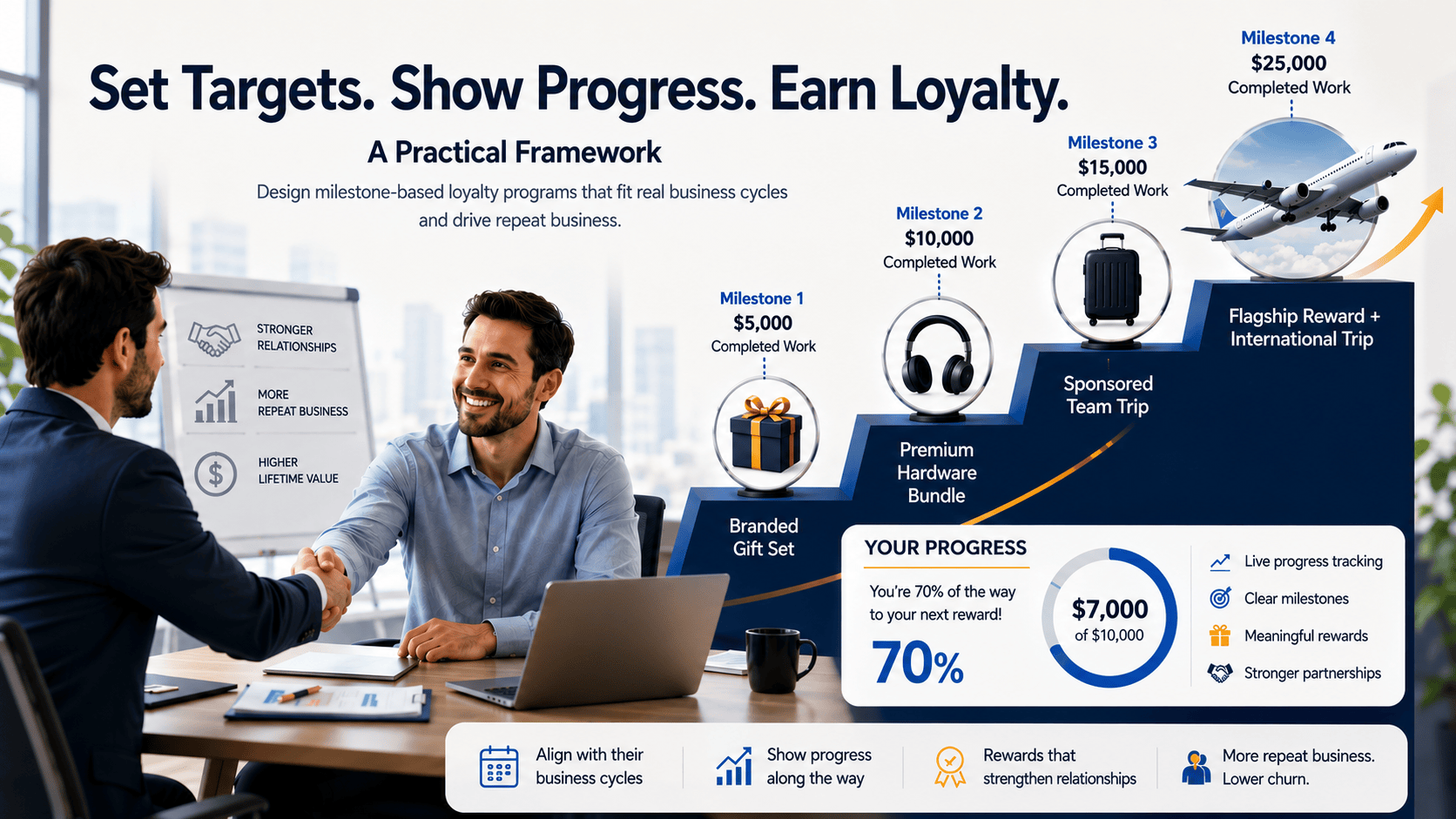
Example: an escalating reward scheme. A provider running a six-month program could set up a few milestones, each one bigger than the last:
| Milestone | Cumulative Target | Reward |
|---|---|---|
| Milestone 1 | $5,000 in completed work | Branded gift set |
| Milestone 2 | $10,000 in completed work | Premium hardware bundle |
| Milestone 3 | $15,000 in completed work | Sponsored team trip |
| Milestone 4 | $25,000 in completed work | Flagship reward + international trip |
A few things make this work well:
- Every milestone feels worth chasing on its own — not just a stepping stone to the big prize at the end.
- Progress adds up over the whole period. If a client does a lot of work early and less later, they still keep full credit for everything.
3. Match the Deadline to the Client's Own Calendar
B2B clients don't buy evenly throughout the year. They have busy seasons and slow seasons, based on their own budgets and plans. A generic 12-month program ignores this.
Instead, set the target window around the client's own rhythm — quarterly if they budget quarterly, seasonal if their work is seasonal. This just fits how they already plan and spend.
It helps you too. You can time the program to encourage more business during your own slow periods, instead of leaving your revenue entirely up to chance.
Example: showing progress along the way. A reward program only works if the client can see how close they are — not just find out at the very end. If a client has done $7,000 of work toward a $10,000 milestone, three months into a six-month program, show them that: "You're 70% of the way to your next reward." Most programs skip this — the targets get set once, and nobody tracks progress until someone checks near the deadline. A simple dashboard that shows live progress keeps the target front-of-mind the whole time, not just at the last minute.
4. Choose Rewards That Strengthen the Relationship
The reward doesn't have to be a discount — and often it shouldn't be. A discount is easy to match, easy to forget, and doesn't make the client feel like anything has actually changed between you.
Better options for B2B clients:
- Free strategy or planning session with your senior team, worth real consulting hours
- A dedicated account manager who knows their business, instead of a rotating support queue
- First access to new services or capacity before they're opened up to other clients
- A guaranteed faster turnaround — days instead of weeks — on their next project
- A sponsored trip, event pass, or experience for their team, if the milestone is a big one
These carry more weight than a percentage off an invoice, because they signal a real upgrade in the relationship — not just a one-time deal the client will forget by their next project.
Set a target that fits the client's own calendar, show them their progress along the way, and make each reward feel bigger than the last. That's enough to give a B2B client a real reason to come back.
Conclusion
B2B clients aren't looking for the cheapest deal on their next project — they're trying to reduce risk on something important to their business. A milestone program that fits their calendar, shows clear progress, and offers meaningful rewards gives them a real reason to keep choosing you. For B2B providers, this isn't a nice-to-have. It's the loyalty mechanic actually built for how these relationships work.
Gamopanda helps brands build challenge and streak mechanics that increase repeat purchases and customer loyalty—without relying on endless discounts.