
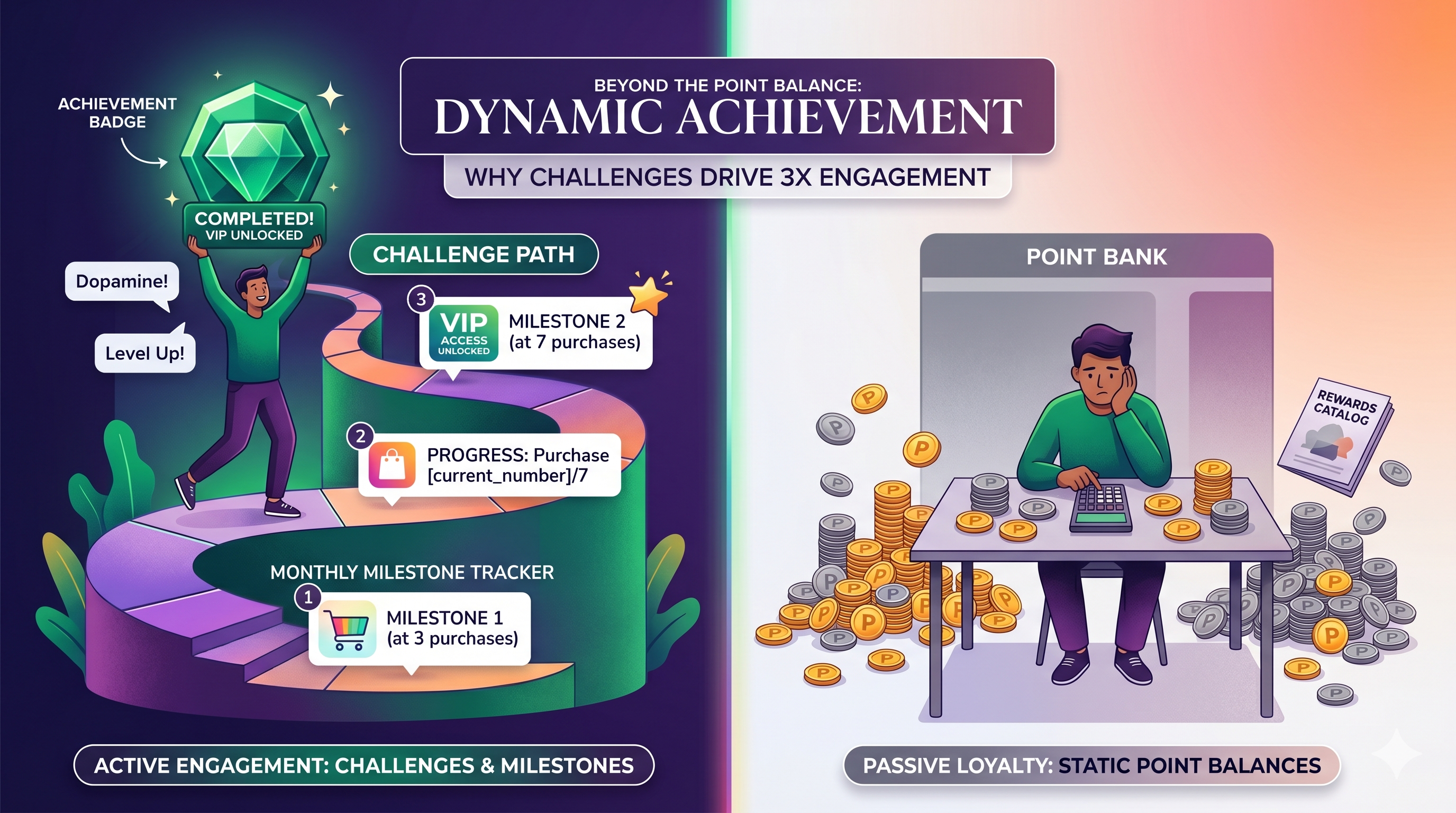
If you give a customer 10 points for buying a coffee, they feel like a line item in your ledger. If you give them a "Weekend Warrior Challenge" to buy three coffees before Sunday for a limited-edition badge, you've turned a transaction into an adventure.
Traditional loyalty programs are failing because they are static. Modern users crave dynamic achievement.
The "Static" ProblemPoints are a currency. Currencies are boring. They require calculation, waiting, and "saving up." Challenges create urgency and meaning. They transform "spending money" into "winning a game."
1. The Power of "Milestone Gold"
Traditional points programs often have a massive gap between "Starting" and "Redeeming." This is the Loyalty Dead Zone. Users lose interest halfway through because the goal feels too far away.
Challenges bridge this gap by using the Goal Gradient Effect. This psychological principle states that as people get closer to a goal, they accelerate their effort to finish it.
The Winning Strategy: Instead of "Earn 1000 points for a $10 voucher," use "Complete 4 purchases this month to unlock a VIP Reward." The finish line is visible, making the user run faster.
2. Active vs. Passive Participation
Points are passive. You earn them as a side effect of buying. You don't "do" points; you just "have" them.
Challenges are active. They require a choice:
- "Do I want to take the 'Healthy Habits' challenge this week?"
- "Can I complete this streak in the next 48 hours?"
This active opt-in creates a much higher level of Brand Commitment. When a user accepts a challenge, they are making a psychological contract with your brand to succeed.
3. Comparison: The Value Gap
| Feature | Loyalty Points | Active Challenges |
|---|---|---|
| User Mindset | "How much is this worth?" | "Can I beat this?" |
| Time Sensitivity | Usually None (Passive) | High (Creates FOMO/Urgency) |
| Community | Private/Individual | Social/Leaderboard-ready |
| Brand Perception | A Discount Provider | An Experience Provider |
4. Unlocking "Non-Transactional" Value
One of the biggest flaws of points-based systems is that they only reward spending. Challenges allow you to reward any behavior that is valuable to your ecosystem:
- Education: "Complete our 'How-To' video series to earn a badge."
- Advocacy: "Refer 2 friends this weekend to unlock the 'Influencer' tier."
- Retention: "Log in 5 days in a row to win a streak-freeze."
Challenges are easier to track technically. Instead of managing a complex, fluctuating "currency balance" in your database, you are simply tracking a boolean "Task Completed" state.
Conclusion: Stop Counting, Start Challenging
Traditional points are a race to the bottom on price. Challenges are a race to the top on engagement. By moving from a "Point Balance" to a "Challenge Dashboard," you move your customer from a transaction-based relationship to an achievement-based one.
The question for 2026 isn't "How many points do they have?" but "What is the next goal they are chasing?"